
Quantifying colony-forming units (CFUs) sounds challenging, but the spread plate technique (or surface spatula method) simplifies the process. This highly reliable method accurately estimates viable bacterial counts and serves as the foundation for the Standard Plate Count protocol used in laboratories worldwide.
Here is a simple, practical guide to doing it yourself.
What Are We Actually Counting?
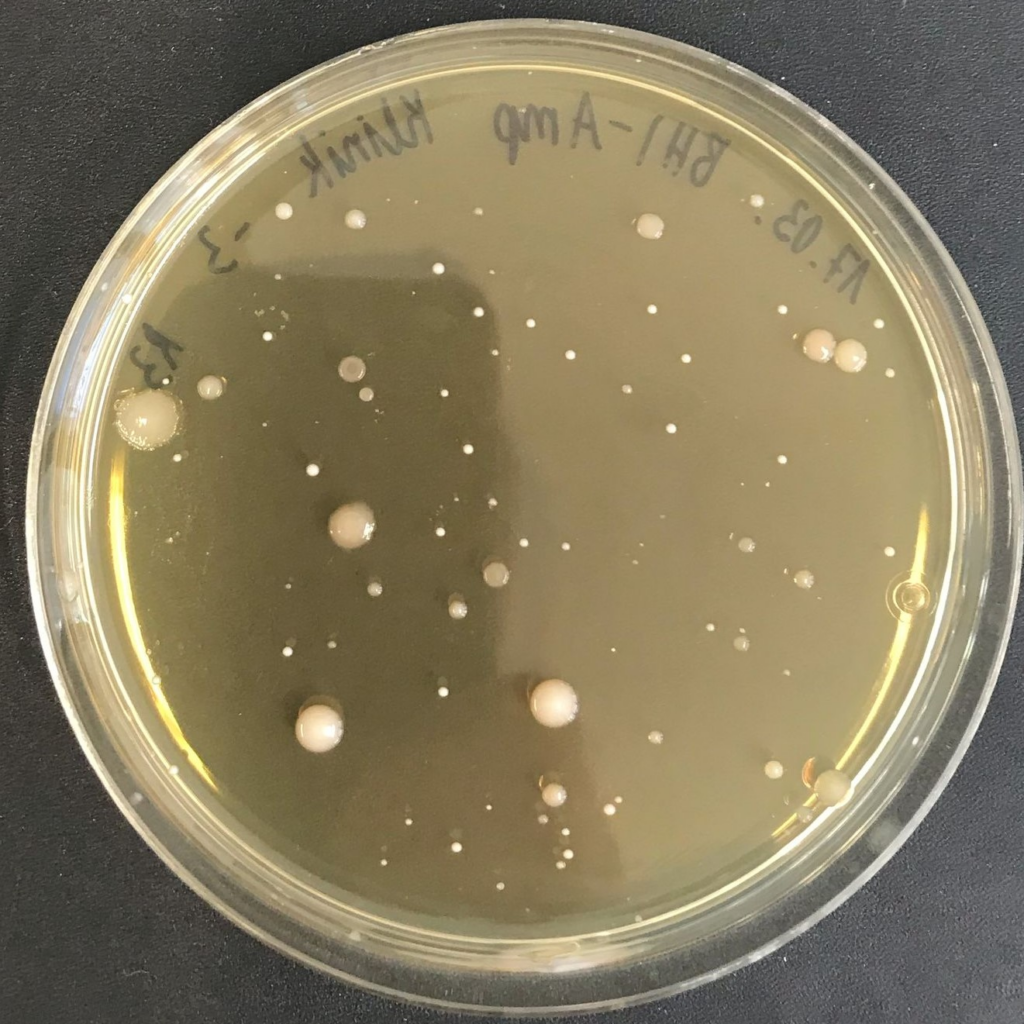
When bacteria grows on an agar plate, each living cell multiplies into a visible cluster called a colony. Because a single colony can start from one or several cells, microbiologists count Colony Forming Units rather than individual bacteria. The key point is that only so-called “Viable Cells“, the ones still alive and able to divide, produce colonies. Dead cells stay invisible. This is why CFU counting gives such a useful picture of a living population.
Step by Step: The Surface Spatula Method
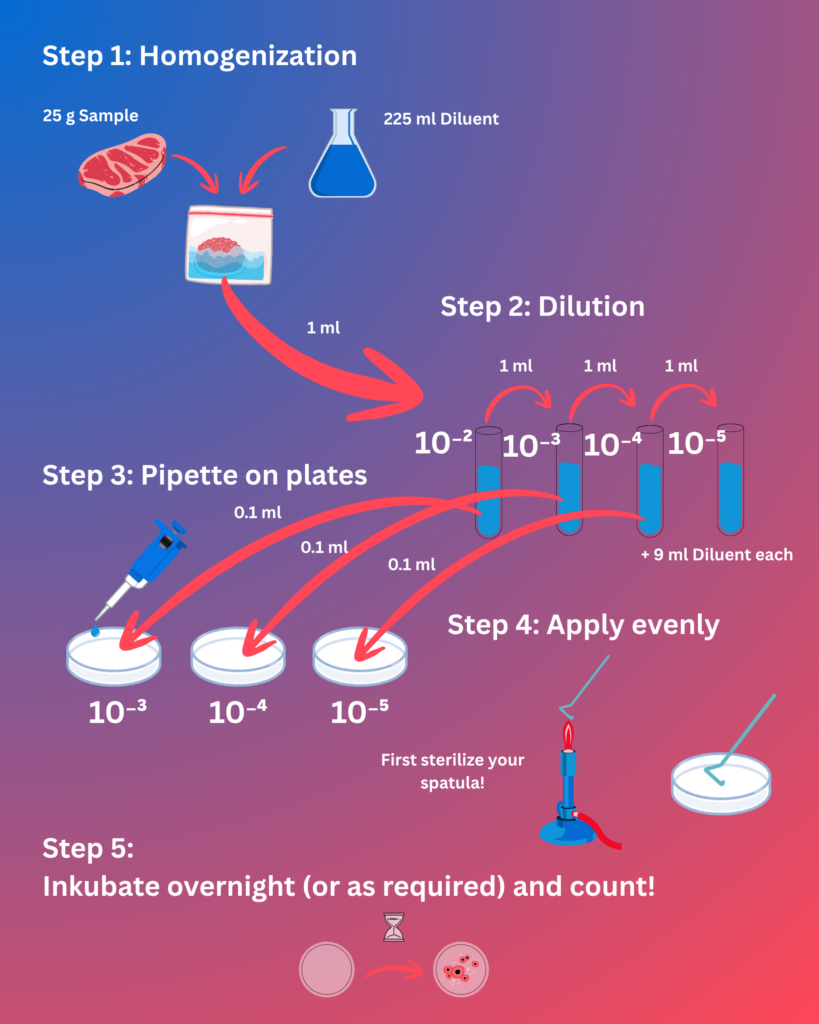
Step 1: Homogenization of your sample
As preparation your sample, e.g. a food product like meat, needs to be homogenized with a sterile mixer and mixed with Peptone Salt Solution*.
*Peptone Salt Solution (often called Maximum Recovery Diluent or MRD) is easy to prepare. For one liter of purified water, you simply need 1.0 gram of peptone (or enzymatic digest of casein) and 8.5 grams of sodium chloride.
Step 2: Prepare serial dilutions
Your original sample is usually too concentrated to count. Dilute it in stages. Transfer 1 mL of your culture into 9 mL of sterile water to make a 1:10 dilution. Repeat this several times, keeping track of each dilution factor. If you are not sure how to often you have to dilute you can use our free tool to play around here:
Free Serial Dilution Calculator
Step 3: Pipette on your plate count agar (PCA)
Pipette 100 µL of each dilution onto the surface of an appropriate agar plate.
Step 4: Spread evenly
Use a sterile spreader (the spatula) to gently distribute the liquid evenly across the surface until it soaks in. Don’t forget to sterilize it first!
Step 5: Label and incubate
Mark each plate with its dilution factor, then incubate overnight or as your organism requires.
Step 6: Count the colonies
Choose a plate with a countable number of colonies, ideally between 30 and 300. Fewer than 30 is statistically weak; more than 300 is too crowded to separate. Carefully count every visible colony.
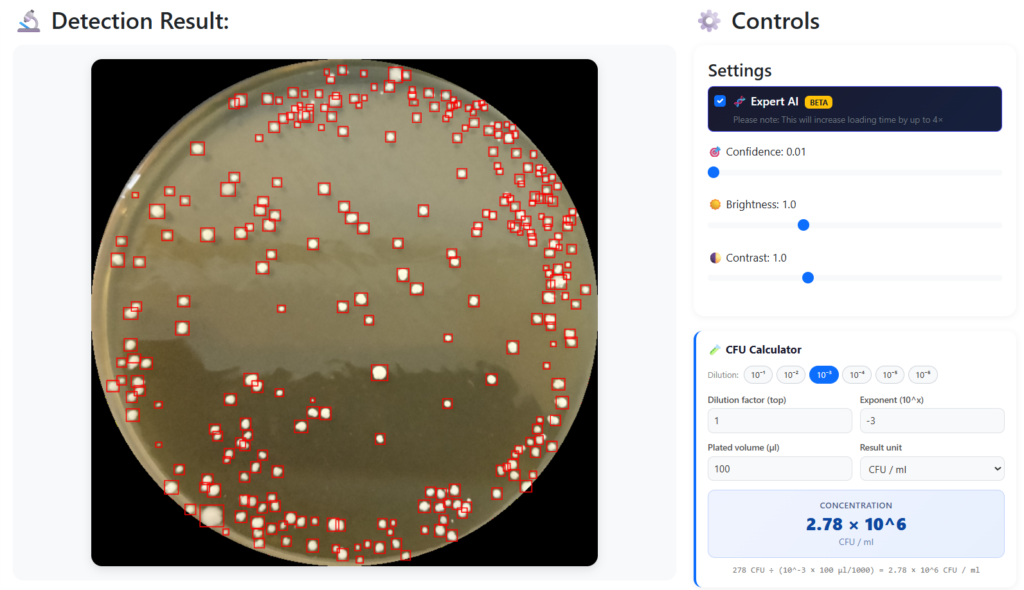
If you want to automize your workflow, you can also use our AI Colony Counting Solution.
Doing the Math
Once you have your colony count, calculate the concentration in CFU per mL:
Total Dilution Factor = Volume plated (mL) x Dilution Factor of the plate
Example Calculation:
You count 150 colonies on a plate from a 1:100 dilution, and you plated 100 µL (0.1 mL).
Total Dilution Factor = 0.1 x 0.01= 0.001
CFU / mL = 150 / 0.001 = 150.000 CFU / mL
Or you can just use our free counting solution here to do the math for you:
Online CFU Calculator
Why Choose This Method?
The biggest advantage is simplicity. It needs no specialist equipment, just plates, pipettes, and a spreader, which is why the Standard Plate Count Method remains a lab staple.
Final Tips
Consistency wins every time. Plan your dilutions in advance, pipette carefully, and be strict about what counts as a single colony. Small errors early on multiply quickly in your final number. With a little practice, counting Colony Forming Units becomes second nature, giving you a dependable snapshot of the living bacteria in any sample.