
Counting bacterial plates by hand or with a hardware device has long been the lab standard — but it’s not the only option anymore.
In this post, we compare hardware colony counter devices with modern, browser-based alternatives to help you decide which fits your lab best. We’ll also take a look on financials and time efficiency.
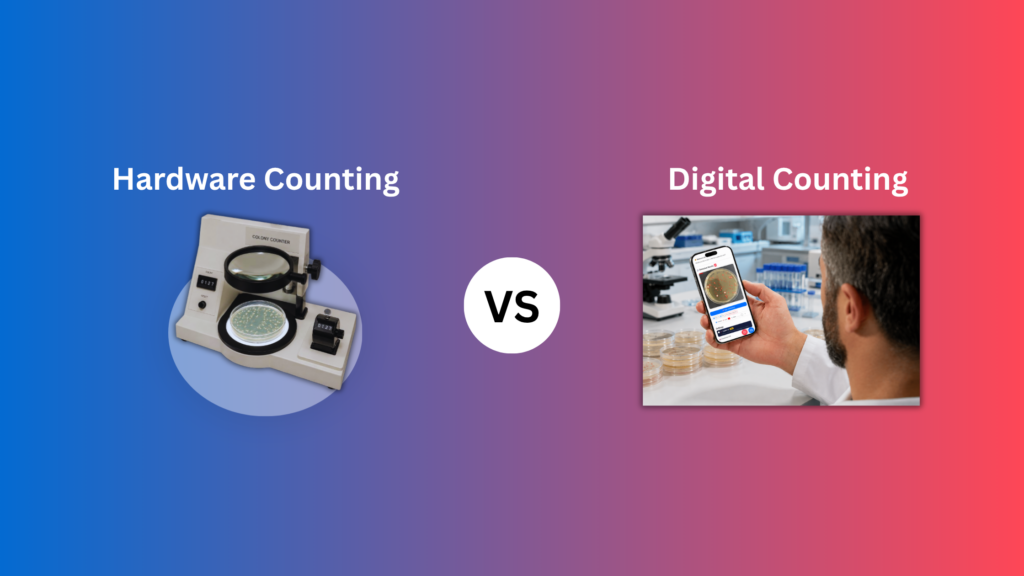
If you’ve ever sat at a bench clicking a pen-style colony counter while squinting at a petri dish for the twentieth time that day, you already know the problem. Manual counting is slow, tiring on the eyes, and surprisingly easy to get wrong on dense plates. Hardware counters were supposed to solve this — but they come with their own baggage: high upfront investment cost, taking space in your lab and maintenance that creeps up over time.
That’s why more labs, students, and startups are switching to online colony counters — browser-based tools that count colonies from a photo in seconds, with no device to buy, ship, or maintain.
What Is a Traditional Hardware Colony Counter?
A colony counter is a physical device — usually a lit platform with a magnifying lens and a clicker pen or touch-sensitive surface. You place your petri dish on the device, and each time you touch a colony with the pen, it registers a count on a small digital display.
These devices have been a laboratory staple for decades, and for good reason: they’re straightforward, don’t require internet access, and many models are validated for regulated environments like clinical or pharmaceutical QC.
But they also carry real downsides — a price tag often between $300 and $15000, a learning curve specific to each model, and the kind of wear-and-tear maintenance you’d expect from any mechanical device used daily.
What Is an Online Colony Counter?
An online colony counter works differently. Instead of a physical device, you photograph or upload an image of your petri dish to a web-based tool. The software analyzes the image and automatically detects and counts colonies — in a matter of seconds.
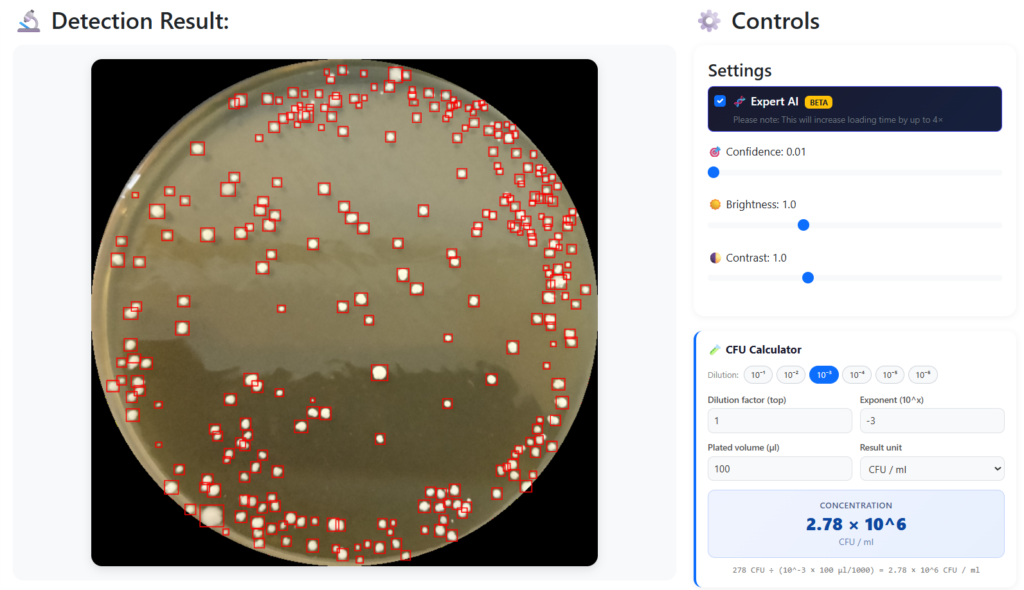
There’s no hardware to unbox, no calibration routine, and no maintenance schedule. You just need a device with a browser — a laptop, tablet, or even a phone and an internet connection. For labs juggling tight budgets or multiple team members who need access to counting tools, this shift removes a lot of friction.
Hardware vs. Online Colony Counter — Side-by-Side Comparison
| Factor | Hardware Colony Counter | Software Colony Counter |
|---|---|---|
| Upfront cost | $300–$15000+ depending on model | Free or low-cost subscription |
| Analysing your result | Manual dilution calculation | Included calculation tool |
| Setup time | Unboxing, calibration, manual setup | Open the app in seconds |
| Maintenance | Sensor cleaning, button/pen wear, occasional repairs | None — runs in the cloud, auto-updated |
| Portability | Tied to one physical location/device | Usable from any device with internet (lab, home, field) |
| Accuracy | Reliable, but prone to human click error on dense plates | Consistent algorithmic counting, reduces manual miscount |
| User learning curve | Minimal but device-specific | Minimal — most users count their first plate in under 1 minute |
| Multi-user access | One device, one user at a time | Multiple team members can use it simultaneously, no extra hardware |
| Data storage / record-keeping | Manual logging (notebook or spreadsheet) | Auto-saves/export-ready results |
| Software/firmware updates | None | Continuous improvements, no action needed |
| Best suited for | High-throughput labs needing certified hardware, regulatory compliance | Students, small labs, startups, field researchers, budget-conscious teams |
The table makes one thing clear: hardware counters aren’t bad — they’re just built for a specific use case. Online counters solve for cost, flexibility, and accessibility, while hardware solves for certified, offline, high-throughput environments.
The Real Cost of Hardware Counters Over Time
The sticker price is only part of the story. Once you factor in the full lifecycle of a hardware colony counter, the cost adds up in ways that aren’t always obvious upfront:
- Investment
Buying an analog colony counter is not financially justifiable compared to a SaaS solution that can be cancelled on a monthly basis. Budget is better spent on new lab machinery or projects than on a bulky device that spends most of its time gathering dust in a corner. - Depreciation
Like most lab equipment, hardware counters lose resale value quickly, and older models often become unsupported. - Repairs and servicing
Clicker pens wear out, sensors drift out of calibration, and replacement parts aren’t always cheap or fast to source. - Cleaning and maintain time
Laboratory Equipment needs to be cleaned and maintained. - Replacement cycles
Most hardware counters have a functional lifespan of 5–10 years before replacement becomes necessary.
None of this means hardware is a poor investment — for high-throughput, regulated labs, it often still makes sense. But for smaller teams or budget-conscious labs, these costs can be the deciding factor in looking for an alternative.
When Hardware Still Makes Sense
To be fair to the tried-and-tested option: hardware colony counters aren’t going away, and there are real situations where they’re still the better choice.
- Regulatory compliance
Some clinical or pharmaceutical environments require validated, certified hardware as part of their QC process. - Fully offline environments
If your lab has no reliable internet access, a physical device removes that dependency entirely. - Extremely high plate volume
Labs processing several hundreds of plates a day with dedicated counting stations may find a dedicated physical device fits their existing workflow better.
If any of these describe your situation, hardware is likely still the right tool for the job — and that’s a completely reasonable conclusion to reach.
Who Should Switch to Online Colony Counting?
For everyone else, an online plate counter tends to fit naturally into day-to-day work without disrupting existing habits. This includes:
- Students and teaching labs
No budget for expensive hardware, and access from any device matters for shared lab spaces. - Small or early-stage labs
Minimizing upfront equipment costs while still getting reliable counts. - Startups and field researchers
Needing a counting tool that travels with them, not one bolted to a bench. - Teams needing multi-user access
Several people can count plates simultaneously without queuing for one physical device.
How to Get Started With an Online Colony Counter
Switching from hardware to an online colony counter doesn’t require any special setup. In most cases, the process looks like this:
- Photograph your petri dish using a phone, tablet, or lab camera.
- Upload the image to the online colony counter tool.
- Let the software detect and count colonies automatically.
- Review and adjust the count if needed, then export or save your results.
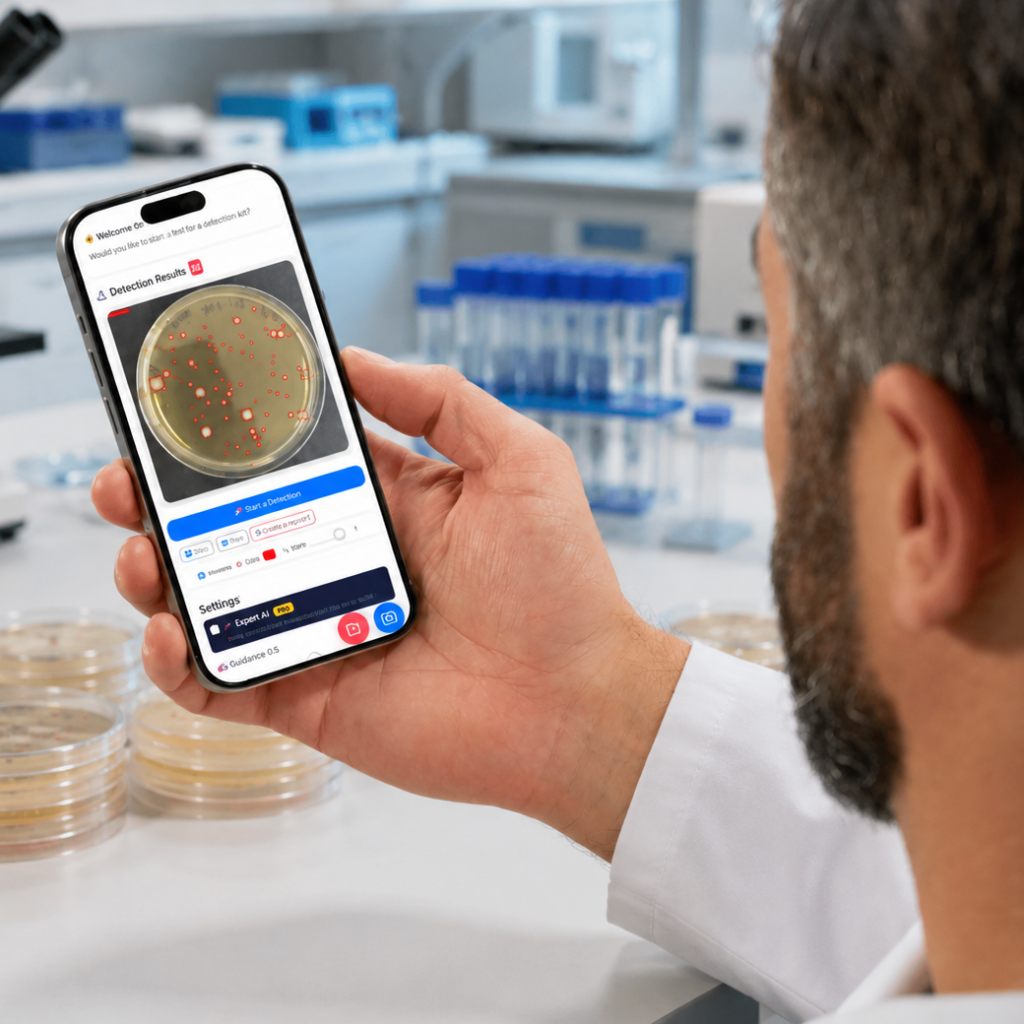
You can do this with our AI CFU counter — no installation and no hardware to maintain.
Frequently Asked Questions
Is there a free alternative to hardware colony counters?
Yes. Some online colony counters are free or available at a much lower cost than hardware devices, since there’s no physical equipment to manufacture, ship, or maintain. We also built a free version that works for a lot applications.
You can test it here.
How accurate are online colony counters compared to manual counting?
Our colony plate counters use image-based AI detection to count colonies consistently, which helps reduce the human error that’s common when manually counting dense or overlapping colonies by eye.
Do I need to buy any equipment to use an online colony counter?
No additional equipment is required beyond a device with a camera (to photograph your plate) and internet access to upload the image and use the tool. Most users use their private or companies phone to upload directly from the lab.
Final Thoughts
Hardware colony counters earned their place in labs for good reason — but for many researchers, students, and smaller teams, they’ve become an expensive habit rather than a necessity. Online colony counters offer a faster, cheaper, and more flexible way to get the same result, without the maintenance overhead or upfront cost.
If your lab fits the profile of teams looking to cut costs without cutting corners on accuracy, it’s worth giving our online colony counter a try on your next plate.